Risks
A tilt table test is generally safe. Complications are rare. But, as with any medical procedure, it does carry some risk.
Potential complications of a tilt table test include:
- Planned episodes of syncope (fainting)
- Nausea
- Palpitations or change in heart rate
- Weakness that can last several hours
- Continued low blood pressure after the test
- Dizziness or headache
- Low blood pressure or high blood pressure
These complications usually go away when the table is returned to a horizontal position. There may be other risks depending on your specific medical condition. Be sure to discuss any concerns with your healthcare provider before the test.
How do I get ready for the tilt table test?
Your healthcare provider will explain the test to you and you can ask questions.
It is recommended to wear comfortable clothes and have an escort. Arrange to have someone drive you home after the test, as you will most likely be told not to drive afterwards.
Food and medications
- Fasting may be required before the test. Your healthcare provider will give you instructions as to how long you should withhold food or liquids.
- Tell your provider of all medicines (prescription and over-the-counter) and herbal supplements that you are taking. You may take your medications as usual unless your health care provider tells you otherwise.
- Tell the technologist if you are allergic to or sensitive to any medicines or latex.
- If you are pregnant or think you may be, tell your healthcare provider.
- Tell your healthcare provider if you have a pacemaker or an implanted cardioverter defibrillator.
- Based on your medical condition, your healthcare provider may request other specific preparation.
What happens during the tilt table test?
The duration of the Tilt Table Test is 45 minutes.
Procedures may vary depending on your condition and your healthcare provider’s practices.
Generally, a tilt table test follows this process:
Before the test
Before the test, your healthcare provider:
- You will be asked to remove any jewelry or other objects that may interfere with the test.
- You will be asked to remove clothing from the waist up and will be given a gown to wear.
- You will be asked to empty your bladder before the procedure.
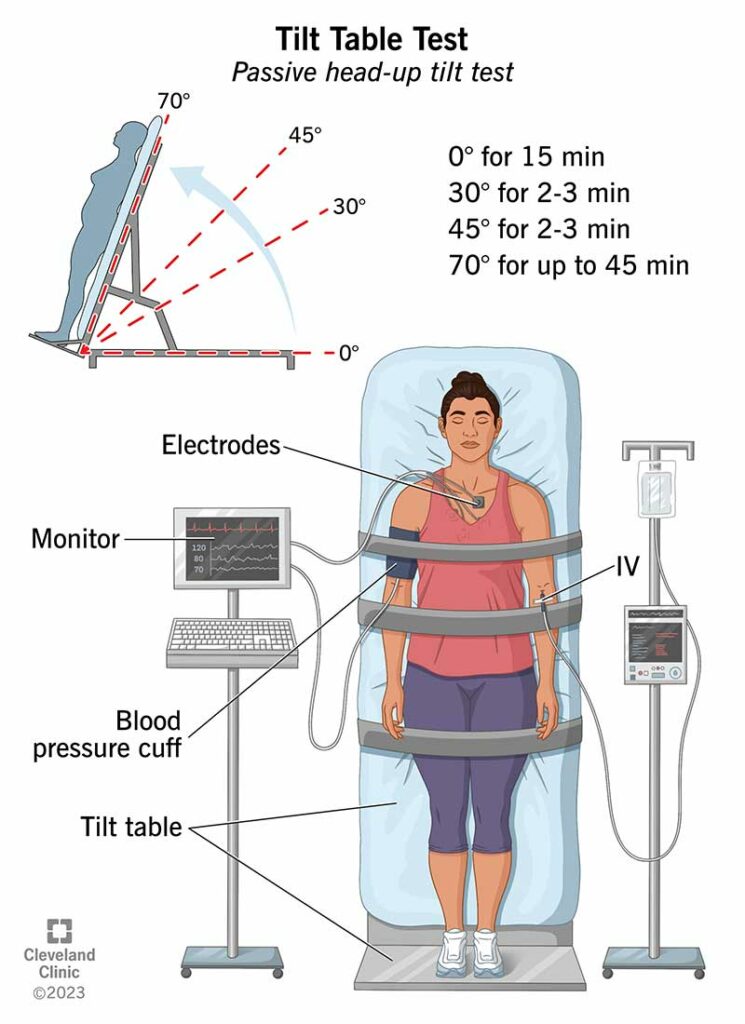
- You will lie down flat on a special bed or table that has a footboard and places straps around you to hold you in place
- An IV line may be started in your hand or arm to inject medicine and to give IV fluids, if needed.
- ECG electrodes will be placed on your chest and attached to an ECG machine with wire leads. A blood pressure cuff will be placed on your arm and will be attached to an automatic blood pressure monitoring machine. Your blood pressure may be measured using an invasive blood pressure monitor called an arterial line instead of a non-invasive blood pressure cuff. The arterial line can provide more rapid measurement of blood pressure changes.
During the test
- You will lie flat on the bed initially, then you will be raised to an almost standing angle while on the bed. Straps will be placed across your chest and legs to keep you from falling if you faint during the test.
- You will remain upright for up to 45 minutes to determine if symptoms such as dizziness, fainting, low heart rate, or a low blood pressure occur.
- If no symptoms occur, you may be given a medicine in your IV to speed up your heart rate. This will be given while you are lying flat again. If you faint while upright, the table will be returned to a horizontal position immediately and you’ll be monitored. Most people regain consciousness almost immediately.
- After the medicine is given (if needed), you will again be tilted upright and monitored for symptoms of dizziness, fainting, low heart rate, or a low blood pressure.
- Once enough information is obtained, you will be lowered to a flat position and allowed to rest for a while. Your heart rate and blood pressure will be monitored.
Your heart rate and blood pressure will be monitored in each position to evaluate your body’s response to the change in position.
After the test
When you are stable, the IV line, blood pressure cuff or arterial line, and ECG electrodes will be removed.
You will be allowed to dress and leave, unless your healthcare provider tells you differently.
You should be able to resume your normal diet and activities, unless your healthcare provider instructs you differently.
Generally, there is no special care following a tilt table test.
Tell your healthcare provider if you develop any signs or symptoms you had before the test (such as dizziness or fainting).
Your provider may give you other instructions after the test, depending on your situation.
Results
The results of a tilt table test are based on whether you faint during the test and what happens to your blood pressure and heart rate.
- Positive result. Blood pressure decreases, causing dizziness or fainting during the test. It usually means the presence of a so-called “Vasovagal Syncope”, and some call it a dysfunction of the puzzled nerve, which is due to the body’s excessive reaction to certain triggers such as seeing blood, emotional pressure or severe pain.
- Negative result. Heart rate increases only slightly, blood pressure doesn’t drop significantly, and there are no signs or symptoms of fainting.
Depending on the results, your care provider might recommend more tests to rule out other causes of fainting.